Last updated November 18, 2026

Free written scope consultation - allowances, timeline, and change-order rules on paper before a single trade is scheduled
Driveway & Pavers Warning Signs Every Homeowner Should Know
A single paver that rocks when you step on it isn’t a nuisance. It’s an early indicator that the bedding layer beneath it has compromised. And if it’s happening in one spot, it’s almost certainly happening in others you haven’t found yet.
We’ve walked hundreds of driveways across Lewisville, and the pattern is remarkably consistent: the homeowners who catch failure early spend a few hundred dollars. The ones who wait spend five figures. This guide teaches you the physical language of paver failure so you can read it yourself: the difference between normal settling and structural movement, why edges fail first, what weeds really mean, and how to document everything before you ever call a contractor.
Quick Answer
The main driveway and paver warning signs are: pavers that rock or sink underfoot, sand washing out of joints, weeds growing in widening gaps, pooling water that lingers more than 48 hours after rain, heaving near the edges, and visible cracks or separation from the foundation. Any one of these suggests the base is moving. Two or more together mean it’s time for a professional inspection, not another round of joint sand.
Styles & brands we work with
- Kitchen remodeling
- Bathroom remodeling
- Home additions & ADU
- Roofing
- Windows & doors
- Driveway & pavers
- Fence
Table of Contents
- Normal Settling vs. Differential Settlement: How to Tell Them Apart
- Why Edge Pavers Fail First
- What Weeds Through Joints Really Tell You
- The Water Pooling Test
- Rocking, Sinking, and Heaving Pavers
- How Lewisville’s Clay Soil and Summer Heat Accelerate Failure
- How to Document and Photograph What You Find
- When Repair Makes Sense and When Replacement Does
Normal Settling vs. Differential Settlement: How to Tell Them Apart
Every paver driveway settles a little. That’s normal, and it’s cosmetic. What matters is how it settles. Normal settling is uniform and gradual: the whole surface drops a fraction of an inch over years, still drains properly, and no paver moves individually under your foot. Differential settlement is the opposite. One area drops relative to the pavers beside it, creating a step, a dip, or a ridge. That’s structural, and it points to a base problem, not a cosmetic one.
Here are the visual patterns that separate the two:
- Uniform slope across the whole driveway, still draining toward the street: normal. Leave it alone.
- A single low spot with a clear step-down at its edges: differential settling. Likely a base compaction failure or a soft pocket underneath.
- A long, straight ridge or valley running in one direction: movement along a joint. Often the route a buried utility trench or poorly compacted subgrade takes.
- Radial depression measured in inches around a specific point: something is washing out below that spot, or the base was never compacted there.
- Pavers that tilt independently of their neighbors: bedding layer has failed locally.
On a properly built paver driveway, the base layer is compacted in lifts and each paver is set into a sand bedding no thicker than about an inch. If you can push a paver to rock it, that inch has become two or three somewhere under there. When we inspect driveways in Lewisville’s Castlewood and Vista Ridge neighborhoods, this pattern almost always traces back to base prep, not to the pavers themselves. Pavers are the visible layer; the base is what carries your vehicles.
Why Edge Pavers Fail First
Walk to the outside edge of your driveway – the one that borders grass, not the house – and press down on the last row. If it rocks, the edge restraint is the problem. Edge restraint is the hidden border of plastic, aluminum, or concrete curb that locks the outer row of pavers in place. It’s the most counterintuitive principle in paving: the weakest point is the only point doing structural work.
Here’s why. Every vehicle that pulls in creates a lateral force pushing the pavers outward. The center pavers transfer that force to their neighbors, and their neighbors transfer it to the edge. The edge restraint is what stops the whole field of pavers from spreading outward like an uncoiled spring. If the installer skipped it, set it shallow, or used a plastic edge that broke during compaction, you get the classic failure signature:
- The outer row of pavers spreads outward and loosens.
- Joint sand starts washing out along the edge first.
- Water gets under the edge and erodes the base from the outside in.
- Within a few years, a band of pavers six to twelve inches wide starts rocking and sinking, while the center remains rock solid.
That pattern – good center, failing edges – is the fingerprint of edge restraint failure. It’s not a paver problem. It’s an installation detail problem, and it’s fixable without replacing the whole driveway if you catch it while the field is still tight. On driveways where the edges are also curving or the driveway meets a slope, like several properties off Lake Vista Drive, the outward force is even higher and the edge restraint matters even more.
What Weeds Through Joints Really Tell You
Most homeowners treat weeds as maintenance. We treat them as diagnostics. Weeds in a paver driveway aren’t a sign that you own a paver driveway – they’re a sign that joint sand has washed out or settled below the surface of the pavers. The joint sand is the seal that keeps water out of the joints, holds the pavers together laterally, and blocks seed from reaching the soil below. When it’s gone, the joints become open channels.
Weed growth is a joint sand failure, not a maintenance issue
Here’s the important distinction. A few weeds along the edges of a well-sanded driveway, especially after a spring of heavy rain, are normal because joint sand loses volume over time. You top it off and move on. But when weeds appear in a line down the middle, or in a cluster in one area, or when the joints look visibly wider and more open underfoot, that’s different. That’s water finding a path into the base.
Open joints let in water, which erodes the sand bedding, which creates voids, which lets pavers move, which opens the joints wider. It’s a feedback loop. Lewisville gets about 39 inches of rain annually with most of it falling in spring and fall thunderstorms, so a driveway here has plenty of water working against it. Add the freeze-thaw cycle we get in January and February – the joint sand expands, cracks, and pushes out – and you’ll see more joint failure in Lewisville than in an equally old driveway in a drier climate.
The test is simple: pour a cup of water on a joint you’re worried about. If it drains away instantly into the joint, the joint sand is gone or displaced. If water beads up and stays, the sand is intact. When the joints near a weed cluster drain instantly, the base under that cluster is being compromised and needs to be looked at.
The Water Pooling Test
This is the single most useful diagnostic a homeowner can run. Do it forty-eight hours after a real rain, or mimic it with a garden hose:
- Wait 48 hours after a significant rain event. Lewisville’s typical spring storm delivers more than enough.
- Walk the entire driveway. Look for water standing in low spots, particularly near the base of the garage door and along the outer edges.
- If it’s dry, run a garden hose at a moderate flow for about 15 minutes over the area you’re worried about.
- Check again after 30 minutes. If water is still pooled, create a written note with a photo of the pool over a tape measure or shoe for scale.
A driveway that holds water more than 48 hours after rain has a drainage failure. Water pooling in one spot means that spot is lower than the surrounding area and the flatwork isn’t shedding water as designed. Pooling water doesn’t just look bad – it saturates the base, weakens the subgrade, and accelerates settlement. We’ve seen driveways in Lewisville’s Old Town district where a low spot near the apron had eroded a void the size of a shoebox under the pavers. The driveway looked flat. It wasn’t.
Two rules seem to hold in our experience: pooling that disappears within an hour is a slope issue that’s annoying but not structural. Pooling that stays more than 12 hours, especially after the source of water stops, points to a real drainage problem below the surface. That’s when you get a professional.
Rocking, Sinking, and Heaving Pavers
Rocking pavers feel like a loose tooth. Step on one, and it pivots. The cause is always a void in the bedding layer beneath it, and the void is almost always caused by water or incomplete compaction. Here’s what the specific feel and location tell you:
- A single paver rocking alone: a localized bedding failure. Usually repairable by pulling that one paver, re-compacting the base, and resetting. But check for the reason it failed – if water is channeling into that spot, resetting it is temporary.
- A diagonal line of rocking pavers: a joint has opened and sand has washed from below. Water is moving along the joint.
- Sinking along the garage apron or a downspout path: water runoff is scouring the base. This is common in Lewisville where downspouts discharge onto or near driveways and homeowners don’t reposition them.
- A ridge or hump where two areas meet: differential heaving, usually from a freeze-thaw cycle over a poorly drained spot or an expansive clay subgrade.
- Pavers heaving up near a tree: roots, plain and simple. Lewisville’s live oaks and pecans send roots under flatwork, and no paver base will survive an active root system pressing up.
Why does North Texas get more of this than a drier climate? The soil. Lewisville sits on the Blackland Prairie and on expansive clay soils. Those clays swell when wet and shrink when dry – sometimes moving several inches over a season. A fully supported paver base can handle some of that movement. A base with voids or uncompacted pockets cannot, and the clays do the rest. If a developer skipped compaction on your lot’s fill before installing the driveway, you’ll see a seasonal rocking pattern that appears in late summer and firms up after fall rain.
How Lewisville’s Clay Soil and Summer Heat Accelerate Failure
The climate here does a specific kind of damage that homeowners moving from other parts of the country often underestimate. Three forces work on a Lewisville driveway:
- Expansive clay movement: The subgrade swells and shrinks with moisture, and any unaddressed void under the pavers opens and closes seasonally. A paver that’s stable in spring can rock by August.
- Intense summer heat: UV exposure and 100-degree stretches dry out the joint sand and accelerate its breakdown. Sand that was set two seasons ago may already be low in the joints.
- Concentrated storm runoff: North Texas gets its rain in short, heavy bursts rather than steady soft rain. A two-inch storm in 40 minutes drives water into open joints and edges far faster than the same volume over a full day.
That combination is why joint sand failure and edge spreading are the two most common issues we see on Lewisville driveways. And it’s why a driveway that looks fine in March can be rocking by October if the homeowner doesn’t top up joints and check edges each spring. If you’re noticing a seasonal pattern – stable in wet weather, rocking in the dry heat – that’s a base issue crying out for attention, not a paver issue. Pavers are rated for decades. The base and the joints are what determine whether you get those decades.
We approach a driveway the same way we approach a fence line or a home addition – base and structure first, aesthetics second. Good driveway work is coordinated the same way, and you can read more about how we handle that on our Driveway & Pavers in Lewisville page. If you’re also planning exterior work around the driveway, the same principles of base preparation apply to Fence Installation in Lewisville, and it pays to coordinate them.
How to Document and Photograph What You Find
This matters more than most homeowners realize. A clear photo record is what turns a warranty claim from an argument into a completed repair. Here’s exactly how to build that record:
- Shoot wide, then close. Take one photo of the whole driveway, then close-ups of each specific problem. The wide shot shows location; the close-up shows the issue.
- Put a reference object in the frame. Lay a tape measure, a coin, or a shoe next to each crack, rocking paver, or pool of water. Without scale, photos get dismissed.
- Photograph after a rain, not after cleaning. Water in the joints and pools in the low spots are evidence. Dry, swept photos show nothing.
- Write the date on each photo. Many phone cameras can add this automatically. A timestamped sequence shows the problem is progressive, not a one-time complaint.
- Keep a simple log. A notebook or phone note that says “June 8 – paver at edge near mailbox rocking. June 14 – two more pavers rocking in line toward center” is powerful in a warranty conversation.
- Photograph what was promised. If your contract says edge restraint will be installed, take photos of the edge as soon as its condition is visible, before it’s buried again.
Build the file early. If you wait until the problem looks severe, you’ve lost the visual record of when it started, and that’s the most valuable part. On our projects, this same documentation standard runs through the 730-Day Done Right Promise – if a driveway isn’t holding up, we want the photos that show it and the warranty that backs it, not a debate about whether it’s an issue.
When Repair Makes Sense and When Replacement Does
Most driveway paver problems are repairable if you catch them early. That’s the whole point of reading the warning signs. Here’s a practical rule of thumb:
- Repair: isolated rocking pavers, drained and open joints, weeds confined to edges, and a small low spot that can be re-leveled. These are typically resolved by pulling the affected pavers, re-compacting and leveling the base, resetting, and re-sanding.
- Repair, but check the edge: a single failing edge band. Often fixable by resetting the edge restraint and the outer two or three rows.
- Repair with drainage work: pooling water with a compromised base under one area. The base gets rebuilt and a drainage solution gets added, but the rest of the driveway stays.
- Replacement: widespread movement across more than roughly a quarter of the driveway, base failures throughout, or a base that was never compacted. At that point the pavers themselves are usually fine – it’s the layer underneath that’s failed and needs to be rebuilt across the field.
One thing to understand about repair work: the contractor you hire for this should be able to show their base preparation process, not just quote you a number. A paver reset done over a soft pocket fails again within a season or two. We’ve seen driveways in Lewisville where a fast fix was done without re-sanding or re-compacting, and the same pavers were rocking again by the following spring. The real fix is always below the surface.
If you’re weighing a driveway repair against a bigger exterior project – a new fence, a home addition, or an ADU that changes how water runs across the lot – coordinate them. On an ADU or addition, the driveway drainage needs to be designed with the new structure, and our team handles those connection points on Home Additions & ADU in Lewisville.
Common Mistakes to Avoid
- Treating one rocking paver as a one-off. A single rocker is almost always the visible tip of a larger base issue nearby. Walk the whole driveway before assuming it’s just one paver.
- Re-sanding without fixing the reason the sand washed out. You can top off joint sand every spring for five years and still have a base problem underneath. Sand is a seal, not a repair.
- Assuming weeds mean “just add a weed killer.” Herbicide kills the visible weed and changes nothing about the open joint that let it in. The joint is the issue.
- Ignoring a low spot because “it drains eventually.” Water that stands for 12 or more hours is eroding the base every time it happens. On Lewisville’s clay, the cycle compounds seasonally.
- Assuming an edge failure is a paver problem. The outer row of pavers didn’t fail – the edge restraint did, or was never installed to spec. Swapping the pavers without fixing the restraint repeats the failure.
- Waiting until the problem is visible from the street. By the time a driveway clearly fails, the base repair is a much larger job. The whole point is to catch it while it’s still local.
- Not photographing on day one. A timestamped photo record from before the problem was severe is your strongest tool in any warranty conversation. If you didn’t take it, you can’t use it.
See the difference
 Before
 After
 Before
 After
 Before
 After
When to Call a Professional
Call a professional if you’re seeing any of these: three or more rocking pavers in one area, water pooling more than 12 hours after a storm, a visible edge failure wider than one row of pavers, a paver that’s sunk by a half-inch or more relative to its neighbor, or a recurring seasonal pattern of rocking that appears in dry weather and firms up after rain. Any of these points to a base issue that a homeowner can’t fix by re-sanding or resetting a single paver. If your driveway is within ten feet of an addition, an ADU, or a foundation wall, get it looked at early – water that’s eroding under the driveway is water that can move toward the structure. If you want a professional eye on it, Groundwork Construction Co. of Lewisville home is where to start.
Groundwork Construction Co. of Lewisville offers free estimates in Lewisville – call (844) 560-4467. You’ll get a written, line-item quote that separates the base work from the surface work, so you can see exactly what’s failing and exactly what fixing it involves.
Frequently Asked Questions
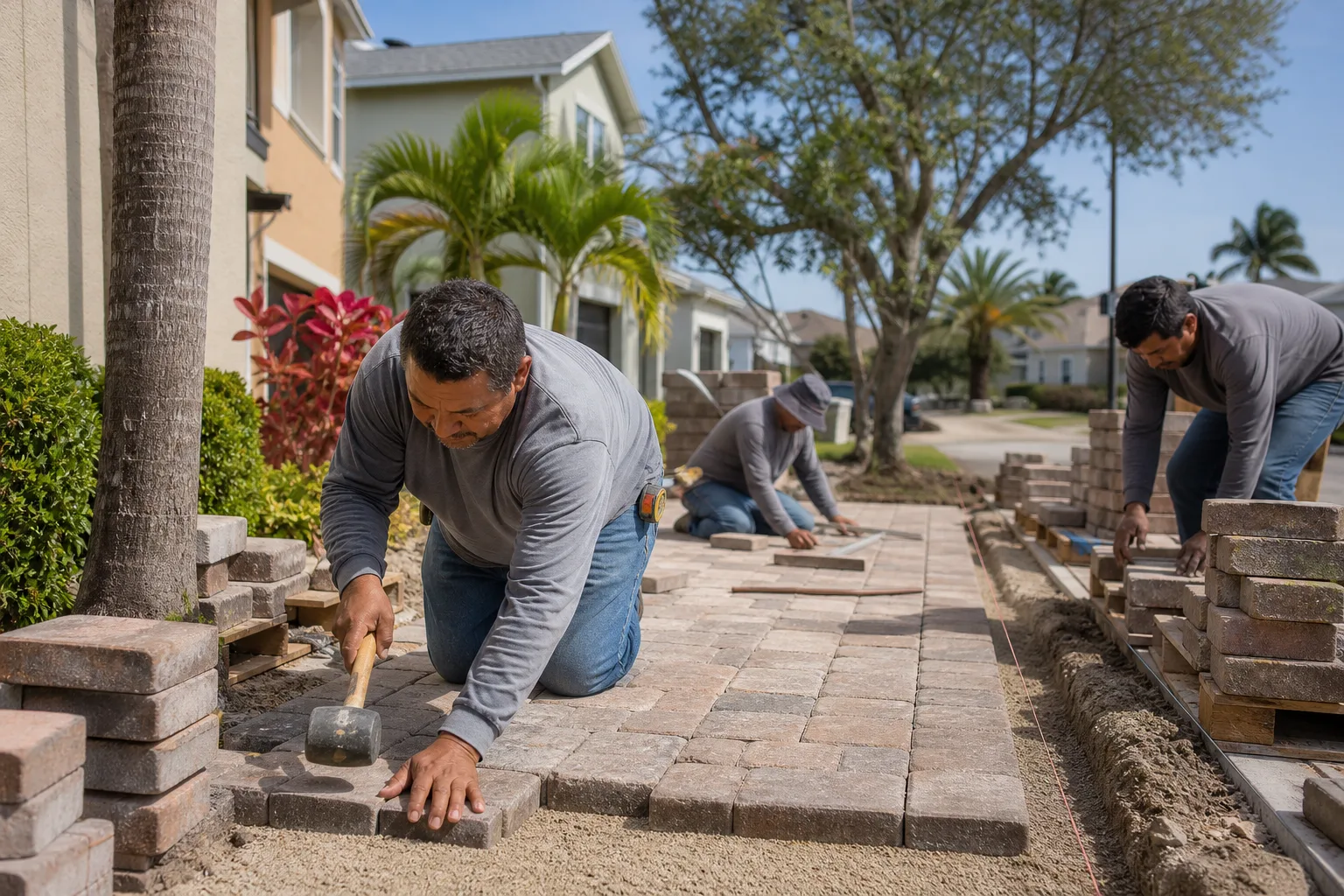
Localized repair – pulling and resetting a handful of pavers and re-sanding the affected area – usually runs a few hundred to about a thousand dollars, depending on the area involved and whether the base needs rebuilding. Fixing an edge restraint that’s failed is typically in the same range. A full base rebuild under one section of the driveway is more because the pavers have to be lifted, the base rebuilt, and the surface re-laid. Call (844) 560-4467 for an exact quote – estimates are free, and you’ll get line-item pricing so you can see what each part of the repair costs.
One rocking paver is worth investigating but not panicking over. A single rocker means the bedding layer beneath that paver has a void – usually from water channeling into it. The concern is that the same water path will undermine the pavers around it, so a one-paver problem becomes a three-paver problem within a season. Have it checked rather than assuming it’s isolated.
Weeds keep returning because the joint sand has failed and the joints are open. You can pull the weeds, but the seed is still there and the sand that should block it is gone. To stop weeds permanently, the open joints need to be cleaned out, dried, and re-sanded – usually with a stabilized joint sand that resists washing out. If the same weeds return season after season in the same area, that’s the base being compromised and letting water through.
Pressure washing removes joint sand if it’s done at high pressure without care. That’s the most common cause of joint failure on an otherwise healthy driveway. If you pressure wash, use lower pressure and keep the wand moving, and plan to top up joint sand afterward. The safer approach is a gentle wash with a surface cleaner and then re-sanding the joints that lost sand.
No. Water that pools and holds for 12 or more hours after a storm is a drainage failure. The pooling spot is a low point where the flatwork no longer sheds water toward the street as designed. When we look at driveways in Lewisville, pooling water is one of the first signs that the base under that spot is being eroded and the pavers will start to sink. If your driveway has drained properly for years and only recently started pooling, get it inspected before the base damage spreads.
It shouldn’t. Get a written, line-item quote that lists the repair scope – how many pavers are being reset, how much of the base is being rebuilt, whether the edge restraint is included, and whether re-sanding is included. If a contractor gives you a single number with no scope, ask for the breakdown. At Groundwork Construction Co. of Lewisville, the number you see is the number you pay, and a line-item quote makes that possible. Call (844) 560-4467 to schedule yours.
The Bottom Line
Your driveway does communicate structural problems months before they become expensive emergencies – if you know how to read it. Rocking pavers mean a void under the bedding layer. Failing edges mean edge restraint problems, not paver problems. Weeds in the joints mean joint sand has washed out and water is getting in. Pooling water more than 12 hours after rain means the base is being eroded. In Lewisville, the clay soil and heavy storm cycles accelerate all of it. Write down what you see, photograph it with a scale reference, and get a professional to look at anything beyond a cosmetic level. Call (844) 560-4467 to schedule your free estimate – our technicians have up to 12 years of experience, and every repair is covered by the 730-Day Done Right Promise.
Written by the team at Groundwork Construction Co. of Lewisville.