Last updated November 18, 2026



Free written scope consultation - allowances, timeline, and change-order rules on paper before a single trade is scheduled
Windows & Doors Warning Signs Every Homeowner Should Know
Interior paint bubbling under a window frame isn’t a paint problem. It’s water getting in from outside, and by the time the bubble shows up on your wall, it may have already been feeding rot into the framing behind it for a season or two. Repainting over that bubble is one of the more expensive mistakes we get called to fix in Lewisville. Windows and doors are the most visible parts of your home’s envelope, but the damage they allow usually starts where you can’t see it: inside wall cavities, behind trim, and in the subfloor right around your thresholds. This guide walks through the signals worth catching early, the ones we see most in Lewisville, and the difference between a window that needs a tune-up and one that needs replacing. By the end, you’ll know what to look at, what to measure, and when it’s time to bring in someone with a moisture meter.
Quick Answer
The warning signs that matter most are water intrusion (bubbling paint, soft drywall, staining at thresholds), air and energy leaks (rising utility bills with no other explanation), and structural movement (doors that stick only at certain times of year vs. doors that suddenly won’t close at all). Most window and door failures announce themselves months before the obvious symptoms like fogging or cracks appear. If you notice any of the interior signals below, get eyes on it before the next storm season in North Texas.
Styles & brands we work with
- Kitchen remodeling
- Bathroom remodeling
- Home additions & ADU
- Roofing
- Windows & doors
- Driveway & pavers
- Fence
Table of Contents
- The Interior Signals That Point to Exterior Failure
- Normal Movement vs. Warning-Level Shifting
- What Your Energy Bill Tells You Before You See Condensation
- Warning Signs to Watch During Installation, Not After
- Workmanship vs. Manufacturer Warranty: Who Pays When Something Fails
- Lewisville-Specific Problems Worth Knowing About
- A 10-Minute Seasonal Walkthrough You Can Do Yourself
- Common Mistakes to Avoid
The Interior Signals That Point to Exterior Failure
The most reliable window and door diagnostics don’t happen at the window. They happen inside the house, and they happen on the surrounding surfaces. When water gets behind siding, flashing, or a door pan, it travels through the wall cavity and shows up at the nearest interior finish. That’s why the signs below are the ones worth taking seriously.
Paint behavior
- Bubbling or blistering under a window sill: classic moisture signal. Water in the wall pushes paint off the substrate from behind. Repainting hides it for a season, maybe two, then it comes back worse.
- Peeling that follows a horizontal line: often traces to a failed sill flashing or a door pan that’s not draining correctly.
- Paint that chalks or fades faster than the rest of the room: suggests UV exposure through a window unit with a compromised seal or an older single-pane unit that shouldn’t have been sold for this climate.
Drywall texture changes
Run your flat palm along the wall directly below and beside a window or door frame. It should feel uniform. A slightly soft spot, a ripple, or a surface that feels cooler than the surrounding drywall is a sign of moisture behind it. If you can press a fingernail into the drywall and leave a dent, the paper facing is compromised. At that point, the wall needs to be opened and the source addressed, not spackled.
Floor material reactions at thresholds
Wood flooring that cups upward near an exterior door, or tile grout that cracks in a straight line following a door frame, are two of the most-missed signals in Lewisville homes. Both point to water wicking in at the threshold. The threshold is where the door meets the weather, and it’s where we find the majority of failed door pans in this market.
Normal Movement vs. Warning-Level Shifting
Houses move. That’s not a defect. Wood expands and contracts with humidity, clay soils in North Texas swell and shrink seasonally, and a door that sticks in August and swings free in December is usually doing exactly what it’s supposed to be doing. The challenge is separating that normal movement from the kind that means something has changed structurally.
Signal check: normal thermal movement
- Doors or windows that stick more in humid summer months and loosen up as temperatures drop.
- Doors that swing open slowly or drift closed on their own.
- Hairline cracks at the corner of window trim that haven’t grown.
- Minor scraping at the strike plate on an interior door, resolved with a small adjustment to the hinge.
Signal check: warning-level shifting
- A door that suddenly won’t latch at all, when it worked fine two weeks ago.
- Visible cracks in the wall running diagonally from a window corner.
- A window frame that has visibly racked out of square. You can check with a level or just by eye at the seam between the frame and the sheetrock.
- A gap that opens at the top or bottom of a door consistently, regardless of season.
- Sticking that gets progressively worse over a month or two, not better with weather changes.
If you’re seeing the second set, it’s time to look at the foundation and the framing, not just the door. We’ve been called out to Lewisville homes where the door was misdiagnosed as the problem for two years, while the actual issue was soil movement under a front corner. A replacement door in that scenario just installs crooked.
What Your Energy Bill Tells You Before You See Condensation
Fogging between panes is the headline window failure story. It’s also the late-stage signal. By the time moisture is visible between the glass, the seal has already been letting in air and water vapor for months. The earlier tell is on your utility bill.
The pattern to watch for
A rising energy bill is normal in the summer in North Texas. What’s not normal is a bill that rises at a rate faster than your neighbors’, or one that climbs year over year on a house where nothing else has changed. If your July bill jumps 15% and you haven’t touched the thermostat settings, the HVAC system isn’t necessarily the culprit. Windows with failed seals lose their insulating gas fill first; argon or krypton doesn’t get replaced on its own. The R-value drops, the HVAC runs longer, and the bill creeps up before there’s any visual evidence at all.
How to isolate the window as the cause
- Compare like-for-like months. Your July 2024 bill against your July 2025 bill, not against the cooler spring months.
- Do a candle test on a windy day. Hold a lit candle (carefully) near your window seams and door sweeps. A flickering flame near a closed window or door indicates air infiltration that shouldn’t be there.
- Feel the glass. A window with a failed seal is often noticeably warmer to the touch on a hot day than a healthy one on the same side of the house.
- Check for condensation on interior glass on cool mornings. Condensation is more advanced, but it starts showing up before the fog between panes appears.
We’ve run this diagnostic hundreds of times in Lewisville, and the honest answer is uncomfortable: a window that fails any of the above is usually only going to fail worse. Seal repair isn’t a real service. Replacement or a full unit rebate through the manufacturer is the practical path.
Warning Signs to Watch During Installation, Not After
The mistakes that cause the worst window and door failures usually happen on the day of installation, and the homeowner has no idea because they’re being shown a clean, level window from the inside. These are the things worth watching for or asking about, whether it’s our crew or anyone else’s doing the work.
- Flashing is skipped or improvised. Every exterior window should have flashing at the sill and the sides, taped or integrated with the weather-resistive barrier. If you see the siding go straight on over the nailing fin without a flashing layer underneath, ask the question.
- The rough opening isn’t shimmed or squared. A window set crooked today will bind in six months. It should be shimmed, checked for level, and operated before final install.
- Spray foam is missing or over-applied. Low-expansion foam around the frame is standard. Standard-expansion foam that bulges the frame out of square is a real failure mode.
- Door thresholds are set on the subfloor without a pan. Exterior doors need a pan or a properly flashed sill. In Lewisville we get the kind of wind-driven rain that finds any gap in a door threshold, and a poorly-sealed pan shows up as a rotted rim joist within a few years.
- Interior caulk is applied before any water testing. If your installer caulks the inside of the window frame before the exterior is finished and tested, they’ve sealed in whatever moisture got in during install.
- No post-install operation check. Every window and door should be opened, closed, and locked before the crew leaves. This is basic, and it gets skipped on busy days.
- Siding is reinstalled without a moisture gap. Vinyl or fiber cement siding should sit slightly off the flashing, not tight against the trim.
If you want to know what a good install actually looks like, this is where brand partnerships matter. When we install Andersen or Pella units for Lewisville homeowners, the installation spec comes straight from the manufacturer, and a job that doesn’t hit that spec doesn’t pass our walkthrough. That’s the difference between a window that performs for 25 years and one that leaks at year three.
Workmanship vs. Manufacturer Warranty: Who Pays When Something Fails
This is the single most misunderstood piece of window and door ownership, and it’s the one that determines whether a repair is free or thousands of dollars out of your pocket.
The two warranties cover different failures
- Manufacturer warranty covers the product itself. If the glass seal fails and fogs between the panes, that’s typically a product defect claim. If the frame warps because of a manufacturing run issue, that’s also a product claim. Manufacturer warranties on windows commonly run 10-20 years on the sealed glass unit and longer on the frame, depending on the brand and model.
- Workmanship warranty covers installation. If water gets in because flashing was skipped, that’s a workmanship claim. If the door won’t latch because the frame was installed out of square, that’s a workmanship claim. If the window leaks at the corner because the caulk and seal behind the trim failed, that’s typically workmanship too.
The distinction matters because the two claims go to completely different companies. If you call the manufacturer for a workmanship failure, you get a polite “not our problem.” If you call the installer for a seal failure, same answer in reverse. Homeowners who don’t know the difference often end up paying out of pocket for a repair that was fully covered by one party or the other.
Why the workmanship warranty is the one that matters most
Product failures are relatively rare. Installation failures are common, and they’re the source of most of the water intrusion we see in Lewisville homes. Which means the warranty that should actually inform your contractor choice is the workmanship warranty, not the manufacturer’s warranty on the product. Any installer can pass along a manufacturer warranty; that’s not a differentiator. What’s a real differentiator is a company that stands behind the install itself, in writing, for years, not just for 30 days after the truck leaves.
This is why our Groundwork Construction Co. of Lewisville home page leads with the 730-Day Done Right Promise. If a window we installed leaks at the flashing in month 18, we come back and fix it. That’s two years of workmanship coverage, which is one of the longest in the residential construction space. It’s the promise that answers the question every homeowner actually asks: if it goes wrong, who pays?
Lewisville-Specific Problems Worth Knowing About
Lewisville sits in a climate band that’s hard on the exterior envelope. Summers push past 100 degrees for weeks, the area gets sudden hail events in spring, the wind can be relentless on the west side of the house, and the clay soils shift seasonally with the rain-dry cycle. All of that works against windows and doors over time in ways that a homeowner coming from a milder climate wouldn’t necessarily recognize.
Signals we see most often in Lewisville
- Door pan failures on homes built in the 1990s and early 2000s. Roof overhangs on those builds were generous but the door thresholds weren’t always flashed correctly. We find soft rim joists on exterior doors in several older Lewisville neighborhoods more often than we’d like.
- Failed window seals on the south and west exposures. The UV load on those faces breaks down the sealant around the glass edges faster than the north and east sides. A house can have three windows failing on the west and zero on the north, and it’s not a coincidence.
- Sticking doors after the wet spring season. The clay soil swells, the foundation shifts a few millimeters, and the doors on the perimeter of the house pick up the movement. This is often normal. It’s the doors that stay stuck into the dry season that mean the foundation needs attention.
- Hail impact on door sides and window trim. Hail doesn’t need to break the glass to compromise the seal around it. Small dings on door frames and window trim can let water past the paint layer over the following seasons.
If you’re doing a bigger project that involves the exterior envelope, it makes sense to have the same crew look at doors, windows, and the roof all at once. Whatever else you’re doing, having the Home Additions & ADU in Lewisville scope and the window scope on the same drawings saves you from two separate contractors pointing at each other when a leak turns up later. The same logic applies to exterior work generally: a window problem rarely lives alone. If you’re already planning to repair a driveway, this is also the season to look at Driveway & Pavers in Lewisville, and if you’re reviewing the exterior envelope, the Fence Installation in Lewisville scope is worth reviewing at the same time since both share drainage and moisture considerations at the lot line.
A 10-Minute Seasonal Walkthrough You Can Do Yourself
Twice a year, ideally in early spring and early fall, walk your house with a flashlight and a notepad. This isn’t a replacement for a professional inspection, but it catches most of the early signals before they turn into urgent problems.
- Walk the interior perimeter at eye level. Look for paint bubbling, cracking, or new dark stains near every window and door.
- Run a hand along the wall below every window sill. Feel for softness, coolness, or ripple in the drywall.
- Open and close every window and door. Note any that bind, drag, or won’t latch. A log of “which doors stuck this season” is surprisingly useful over two or three years.
- Look at threshold transitions. Check for cupping hardwood, cracked grout, or dark staining on the floor near exterior doors.
- Do a candle test on a windy day. Hold a candle near the seam of every window and door. Any flicker is air infiltration worth investigating.
- Step outside and look at the trim and flashing. Caulk lines should be intact. Siding should sit proud of the flashing, not flush against it. Any gap is a place water will get in.
- Look at the exterior paint on door frames and window trim. Peeling paint on the exterior at the sill means water is sitting there. That’s the same water that will eventually bubble the interior paint.
- Photograph what you find. Dated photos are the single best tool when you’re talking to a contractor or filing a warranty claim.
Common Mistakes to Avoid
- Repainting over a bubbling window or door frame. The bubble is a symptom. If you paint over it without addressing the source, the moisture keeps working on the framing for another season, and you’ve paid a painter to hide the evidence.
- Assuming fog between the panes is the first symptom. It’s the last one. By the time glass fogs, the seal has been compromised and the R-value has been slipping for months. Watch the bill and the interior wall first.
- Calling the manufacturer for a leak at the flashing. Flashing is a workmanship issue, not a product issue. Calling the wrong party wastes a month and often ends with the homeowner paying for something that was covered.
- Replacing the door when the frame is the problem. In Lewisville we see this often on homes with active foundation movement. A new door in a moving frame installs crooked and starts misbehaving within a year. Fix the underlying issue first.
- Choosing the cheapest bid for window replacement. The price difference between a good install and a cheap one is usually a few hundred dollars per window. The cost of a leak that runs for two seasons before it’s caught can be tens of thousands of dollars in rotted framing, subfloor, and drywall.
- Skipping the post-install operating check. Open every window and door after installation. Lock every lock. Do it before the crew leaves, not a week later when they’ve moved to another job.
- Ignoring minor sticking that gets worse slowly. A door that sticks a little more each month is telling you something. A door that sticks in August and swings free in November is probably just doing what houses do.
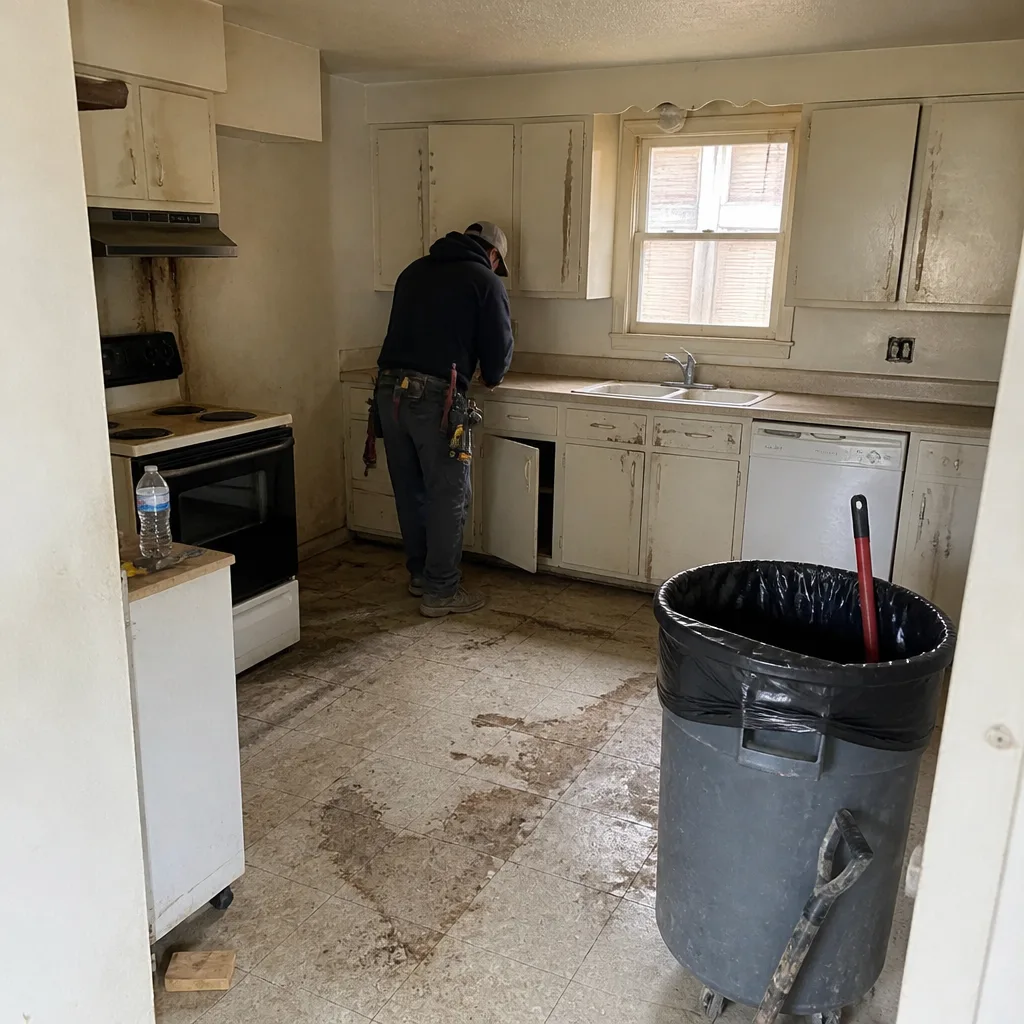
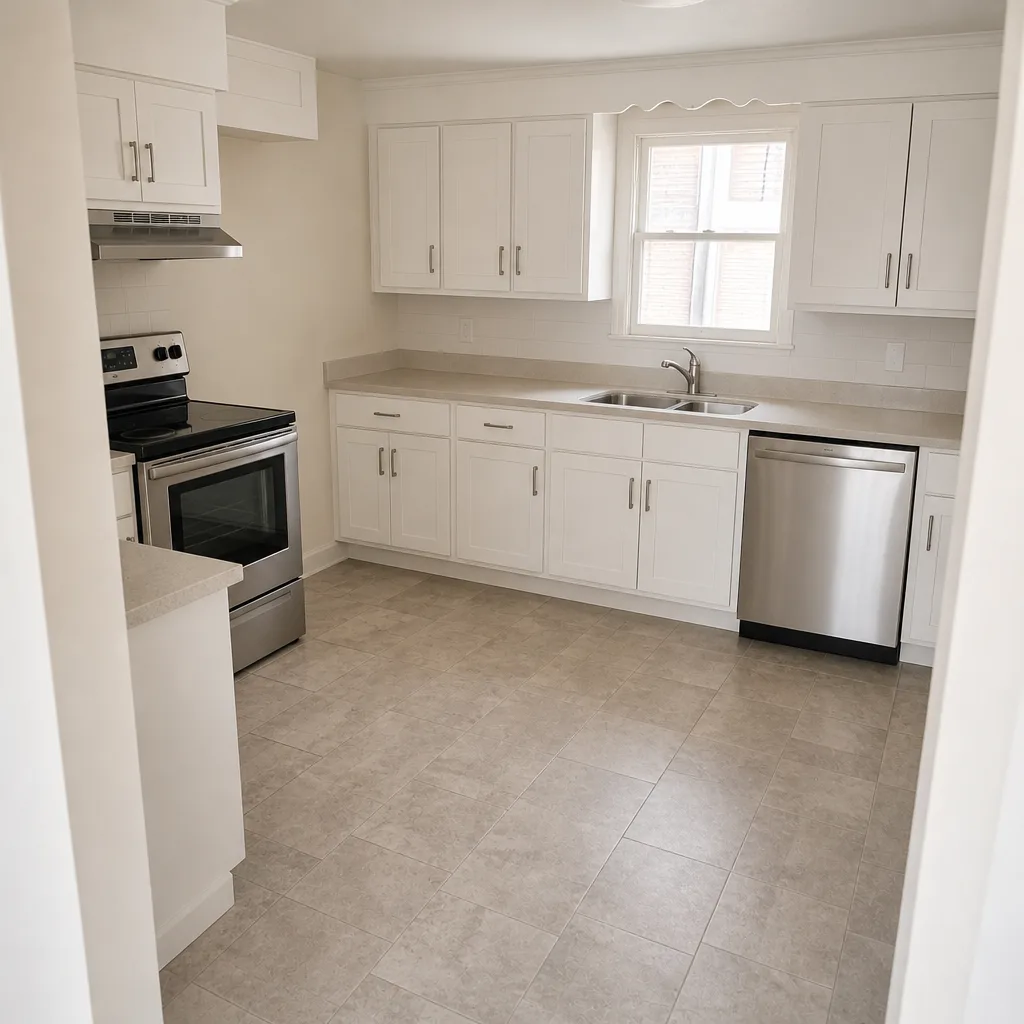
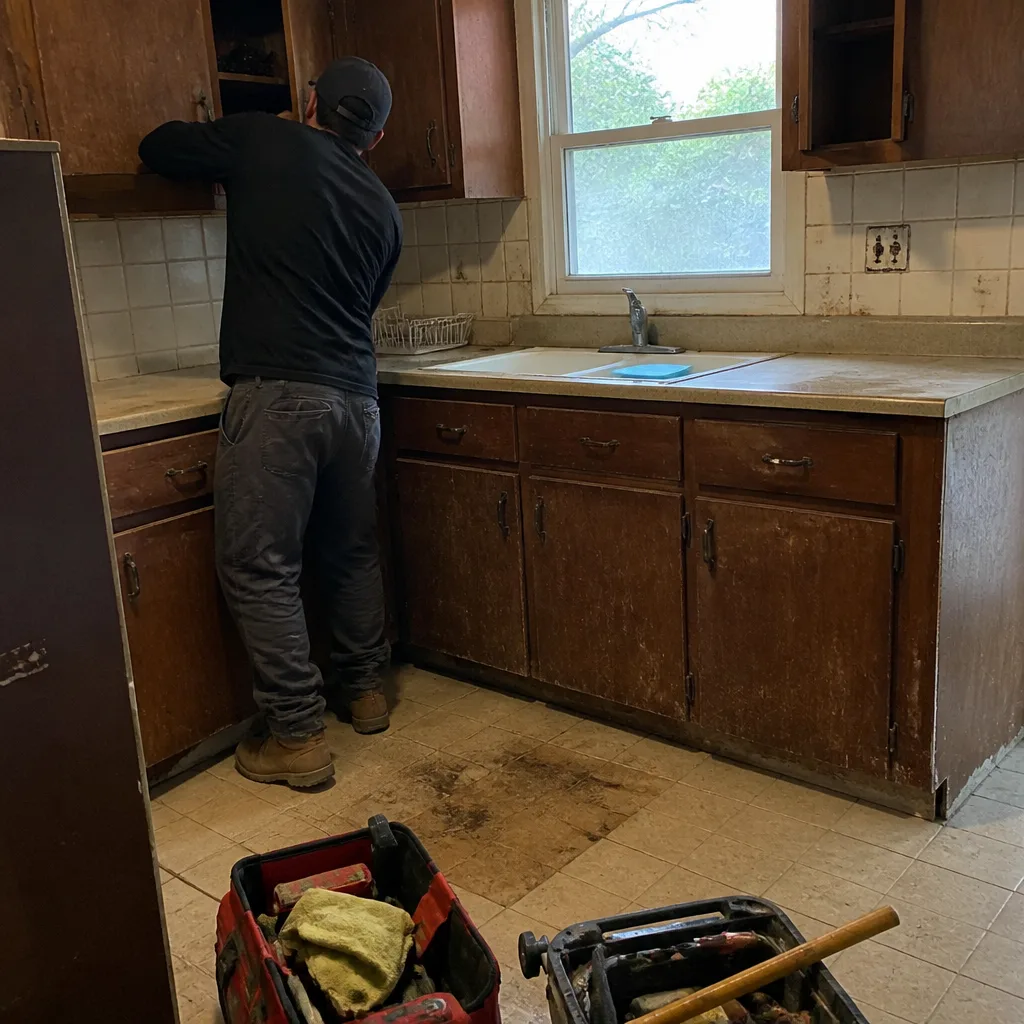
See the difference
 Before
 After
 Before
 After
 Before
 After
When to Call a Professional
Call a professional the moment you find water staining, soft drywall, or paint bubbling near a window or door. Those three signals mean moisture has already been in the wall long enough to damage the interior finish, which means the exterior issue has been active for a season or more. Call if a door that used to work has stopped latching, if fog appears between window panes, if your energy bill has climbed noticeably year over year with no other explanation, or if your seasonal walkthrough turns up two or more of the warning signs from the lists above. If you’re planning window replacement as part of a larger project, get the diagnostic done before you scope the new work; replacing a window on top of an unfixed flashing problem just resets the clock. Groundwork Construction Co. of Lewisville offers free estimates in Lewisville. Call (844) 560-4467 to schedule yours, and a live person will answer, day or night.
Frequently Asked Questions
If the glass seal has failed (fogging between panes) or the frame is warped or rotted, the window needs replacing. If the window operates correctly and the seals are intact, but the flashing or caulk around the frame has failed, that’s a repair. The dividing line is whether the window unit itself is compromised. A quick way to check: open the window, run your hand along the interior frame, and see if any part of it feels soft or looks swollen. Soft or swollen means replacement.
Yes, within limits. North Texas clay soils swell in the wet season and shrink in the dry season, and exterior doors pick up a millimeter or two of movement as a result. A door that sticks slightly in July and frees up in October is doing what houses in this climate do. A door that stays stuck year-round, or gets progressively worse over several months, is not normal. That pattern usually points to foundation movement or a door frame that’s racking out of square. Call (844) 560-4467 for a free estimate if you’re seeing the second pattern.
The manufacturer warranty covers the product itself, usually for 10-20 years depending on the brand and the component. The workmanship warranty covers the installation, which is what more often fails. If you have a leak at the flashing or the threshold, that’s workmanship. If the glass seal fails and fogs, that’s product. The two claims go to different companies, and knowing which is which is how you get the repair covered instead of paying out of pocket. Ask any contractor you’re considering exactly what their workmanship warranty covers and how long it runs.
Twice a year is the right cadence: early spring before the storm season and early fall after the summer heat. Each walkthrough should take 10 to 15 minutes and cover the interior perimeter, the exterior trim, the operation of every window and door, and a check of the energy bills against the same season last year. Take photos with dates every time. The pattern over multiple inspections is what tells you whether an issue is stable or getting worse.
Yes, and often before there’s any visible sign. A failed seal lets the insulating gas fill escape, which drops the R-value of the unit. The window still looks clear because the fogging happens later, but the window is already performing like an older, lower-efficiency unit. On a typical Lewisville home, a handful of failing windows can add a noticeable amount to a summer electric bill, and the increase shows up before the utility is aware of any other problem. If your bill is climbing and the HVAC has been serviced, the windows are the next place to look.
That depends on the cause. Leaks at the flashing, threshold, or caulk lines are workmanship failures and should be covered by the installer’s workmanship warranty. Leaks through the glass or the frame itself are product failures and go to the manufacturer. If your installer is still within their workmanship warranty period, and the leak traces to installation, the repair is on them. This is exactly the scenario that makes the workmanship warranty the one worth asking about up front. Our 730-Day Done Right Promise covers workmanship for two full years, and we encourage Lewisville homeowners to compare that window against anyone else’s before choosing an installer.
The Bottom Line

The most expensive window and door problems start invisibly. Bubbling paint, soft drywall, cupped flooring at a threshold, and a slowly climbing energy bill are all symptoms of water and air leakage that started behind the trim months before the visible damage. Normal seasonal movement is fine; doors that stick year-round or windows that rack out of square are not. The two warranties that matter cover different failures, and knowing which is which decides who pays. If you’re seeing more than one warning sign from this guide, get a professional out to look before storm season. Do the twice-a-year walkthrough, take dated photos, and call for help while the repair is still a repair, not a rebuild.
Ready for a professional look at your windows and doors? Groundwork Construction Co. of Lewisville writes free estimates with line-item pricing, pulls the permits our work requires, and stands behind every install with the 730-Day Done Right Promise. Calls are answered by a live person 24 hours a day, seven days a week. Call (844) 560-4467 to schedule your free estimate and let a background-checked, uniformed technician walk your envelope with you.
Written by the team at Groundwork Construction Co. of Lewisville.